
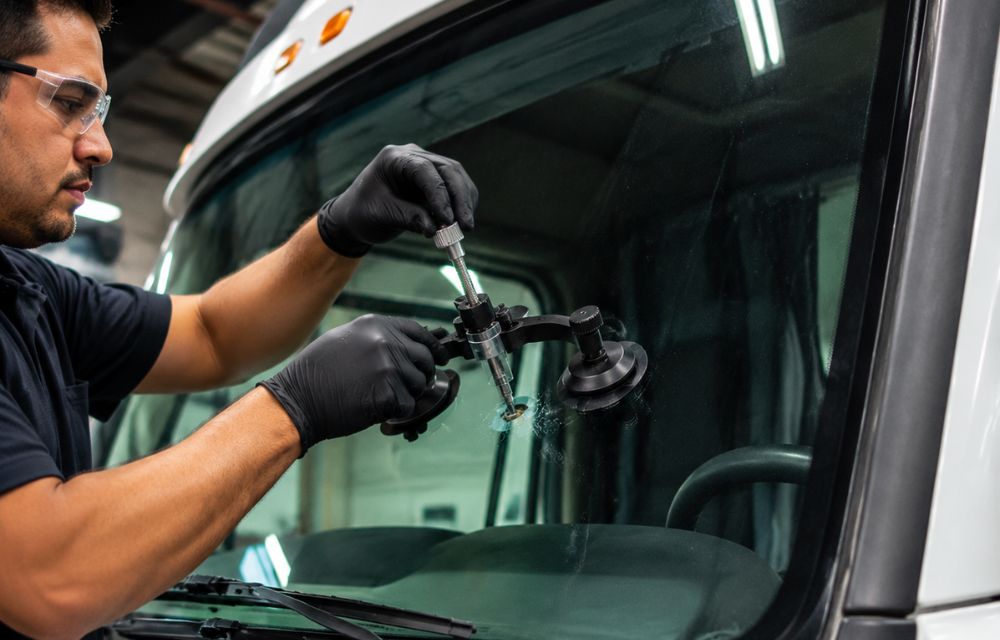
Truck drivers and fleet managers in Qatar deal with a wide range of vehicle maintenance challenges, but glass damage is among the most common and disruptive. Unlike standard passenger car glass, truck windshields and windows are subjected to much harsher conditions — longer hours on the road, exposure to highway debris at higher relative speeds, greater vibration from heavy loads, and more extreme temperature variations. Understanding the common types of truck glass damage helps fleet operators identify problems early, assess their severity accurately, and make informed decisions about Truck Glass Repair versus full replacement. This guide explains the most frequently encountered truck glass damage types and what each one means for the vehicle's safety and operability.
Stone chips are by far the most common form of truck glass damage encountered on Qatar's roads. When a truck travels at highway speed, it follows other vehicles — including other trucks and construction equipment — that regularly kick up road debris. Small stones, gravel, and road surface fragments strike the windshield with significant force and create chips — small, localized impact points where the glass surface has been broken.
Not all chips are equal in terms of their risk and repairability. Small bull's-eye chips, star cracks, and half-moon chips that are smaller than a coin and located away from the driver's primary sightline can often be repaired using resin injection techniques. However, chips that are directly in the driver's line of sight, chips located at the edge of the glass where structural integrity is most important, and chips that are combined with longer cracks typically indicate that full replacement is the safer option.
Addressing stone chips as early as possible is important because the damaged area is vulnerable to further cracking, particularly when the vehicle is driven, when temperature changes cause the glass to expand and contract, or when the truck goes through a wash. A small chip left unattended can develop into a long crack that requires full replacement where prompt repair would have been sufficient.
A star crack is a stone chip impact that has created multiple cracks radiating outward from the central impact point, resembling the shape of a star. The multiple crack lines indicate a higher impact energy or a weaker area of glass, and star cracks are generally more structurally compromising than simple bull's-eye chips. Whether a star crack can be repaired or requires replacement depends on the size of the crack field and its location on the glass.
Long cracks are linear fractures that extend across a significant portion of the windshield surface. They may begin from an initial stone chip impact that was not addressed, or they may result from a more severe impact, from significant structural stress on the vehicle, or from temperature shock — such as the windshield being exposed to cold water or air conditioning immediately after being in intense heat. Long cracks almost always compromise the structural integrity of the windshield and typically require full replacement rather than Truck Glass Repair.
In Qatar's climate, where temperature differentials between the hot exterior and air-conditioned cab interior can be extreme, thermal stress is a meaningful contributor to long crack formation in truck glass.
Edge cracks originate at or very near the edge of the glass panel and typically run inward from the perimeter of the windshield. They are particularly serious because the edge of the glass is the point where the panel is bonded to the vehicle frame, and cracks in this area directly compromise the windshield's structural contribution to the vehicle's safety cage. Edge cracks almost always require full replacement because repair materials cannot restore the structural integrity of glass that is cracked at its bonding perimeter.
Laminated glass — which is standard for truck windshields — consists of two layers of glass with a plastic interlayer (polyvinyl butyral) bonded between them. Delamination occurs when this bond between the glass and the plastic layer deteriorates, creating areas where the layers have separated. This appears as a cloudy, milky, or bubbly discolouration within the glass panel rather than on its surface.
Delamination cannot be repaired — once the bond between layers has failed, the glass must be replaced. The condition progressively worsens over time, degrading visibility and the glass's ability to perform its safety function.
Also Read - Common Causes of Truck Glass Damage
Surface scratches on truck glass are often caused by worn or damaged windshield wiper blades dragging grit and debris across the glass surface, by incorrect cleaning techniques using abrasive materials, or by contact with vegetation or other objects on or off the road. Light surface scratches may be polishable depending on their depth and location, but deeper scratches that interfere with the driver's sightline cannot be polished out and necessitate glass replacement.
Understanding the common types of truck glass damage equips fleet managers and truck operators in Qatar to make informed decisions about when prompt Truck Glass Repair is appropriate and when full replacement is the safer and more cost-effective course of action. In every case, leaving glass damage unaddressed is never the right decision — even minor chips can develop rapidly into major structural issues, and compromised windshield glass is a direct threat to driver safety. Working with a specialist truck glass service that understands the specific demands of commercial vehicle glass is always the recommended approach.
Posted on: June 07, 2026