
We think of motor vehicle safety in terms of seat belts, airbags, and crash test ratings. Yet one essential safety feature that keeps passengers safe every day — and gets overlooked mainly in the process — is car safety glass. From its early days as a basic clear divider to today's advanced protective guard, car safety glass has evolved tremendously. In this blog, we will explore the remarkable history of car safety glass, from its basic to its high-tech features, which we depend on today for visibility, security, and protection.
Car windshields and windows do more than merely exclude the wind — they are essential to structural integrity as well as passenger safety. In crashes, the glass serves as an initial barrier of protection, keeping occupants from being thrown out and shielding them from projectiles. But that wasn't always the case—the first cars employed regular glass, which shattered on impact and inflicted gruesome wounds. Fortunately, the history of car safety glass has evolved miles beyond, combining science, engineering, and safety standards.

The first cars, in the late 1800s and early 1900s, utilized ordinary plate glass for their windshields and windows. Though it provided clarity and a general cover against the outside environment, this form of glass was perilous when involved in accidents. When damaged, it would break into sharp pieces, posing a significant hazard to passengers.
This threat sparked increasing concern, and by the 1920s, people started seeking alternatives. The breakthrough came when French chemist Édouard Bénédictus accidentally discovered laminated glass. When he observed that a glass flask with cellulose nitrate coating would break but remain intact, he realized the potential. This idea formed the basis of the first car safety glass.
By the 1930s, laminated glass was the norm for front windshields. Laminated glass is typically composed of two pieces of glass with a plastic middle layer, generally polyvinyl butyral (PVB), sandwiched between them. This structure keeps the glass from shattering into jagged pieces when it breaks.
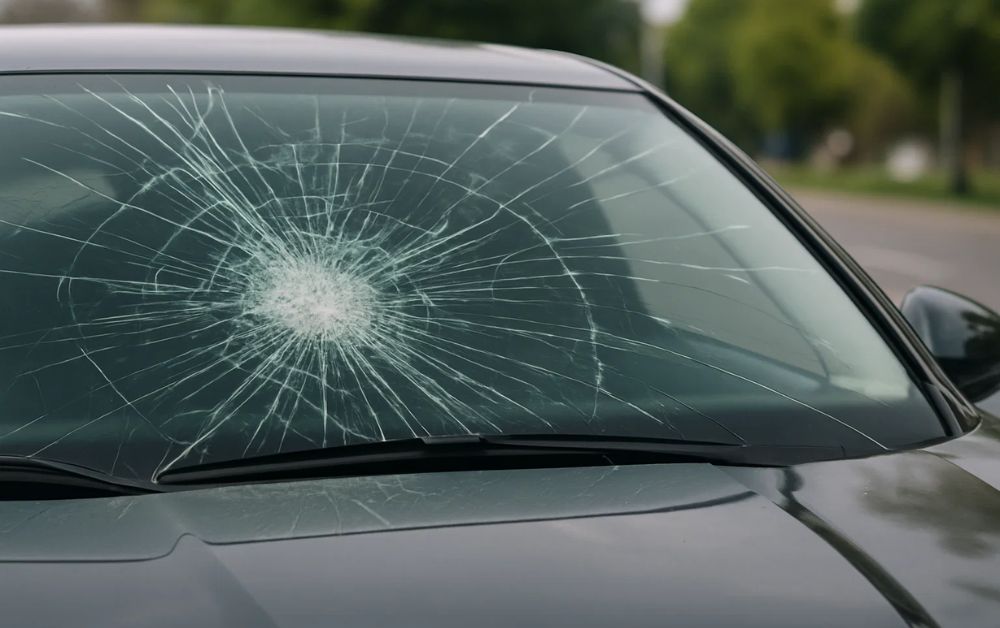
When a vehicle accident occurs, the laminated windshield shatters, but the fragments adhere to the plastic layer, reducing harm from shattered glass. The invention significantly enhanced automobile safety and became legally mandated in most countries over time.
While laminated glass became the norm for windshields, tempered glass technology was adopted for side and rear windows. Tempered glass is formed by heating and then immediately cooling it, making it considerably stronger. When broken, it shatters into tiny, dull-edged fragments, lessening the potential for serious harm.
By the middle of the 20th century, tempered glass was standard in every auto window except the windshield. This two-pronged strategy — laminated in the front, tempered in the sides and back — was the foundation of automobile safety glass for decades.
As vehicles sped up and roadways became congested, the need for safer vehicles led to more stringent regulations and ongoing development of car safety glass technologies. Governments worldwide, including the National Highway Traffic Safety Administration (NHTSA) in the U.S., have begun to make safety standards for automotive glazing mandatory.
Advances were not just in strength and shock resistance but also glare reduction, UV protection enhancement, and visibility enhancement. Anti-fog coating, tinting, and sound deadening were incorporated to improve comfort and safety.
The automotive safety glass of today is a testament to technological advancements. It involves various layers and innovative features that perform a range of functions other than crash protection:
All these aspects not only enhance safety but also make driving more comfortable and energy-efficient.
Looking to the future, car safety glass is becoming increasingly intelligent. Advanced Driver Assistance Systems (ADAS) increasingly depend on camera and sensor integration in the windshield. The sensors track lane departure, pedestrian activity, and automatic braking. To enable these technologies, car glass is now being manufactured with a focus on precision to provide clear camera vision and accurate calibration.
Another upcoming innovation is electrochromic glass, which can electronically adjust tint levels. This active feature provides glare reduction and the best lighting conditions for motorists.
Glass will have an even greater function in autonomous vehicles. Panoramic glass roofs, heads-up displays (HUDs), and touch-sensitive surfaces are likely to become commonplace. These visionary applications require cutting-edge materials that strike a balance between strength, flexibility, and interactivity.
Today's consumers also have concerns about sustainability, and automobile safety glass producers are taking notice. Companies are investing in green manufacturing practices and recyclable materials. Advances in glass recycling technology enable the reuse of glass elements in new automobile models, supporting the creation of a circular economy.

The evolution of automobile safety glass from a simple sheet of breakable glass to a smart, multifunctional element reflects the automotive industry's commitment to innovation and safety. With every step forward in technology, we witness improved roads, reduced injuries, and intelligent cars.
As autonomous and electric cars gain momentum, the role of car safety glass will expand, not only as a passive shield but also as an active component of the car's intelligence and safety systems. Whether protecting us from danger or incorporating sophisticated sensors and display screens, car safety glass continues to improve, keeping us safer and more connected on every ride.
Posted on: September 28, 2025